The primary focus of our laboratory is the general area of “ecological physiology.” Specifically, we study the interactions among the nervous, endocrine and immune systems and behavior in a variety of ecologically-relevant environmental contexts using the Siberian hamster (Phodopus sungorus) as our model system.
CURRENT PROJECTS
Neuroendocrine-Immune Interactions and Sickness Behaviors
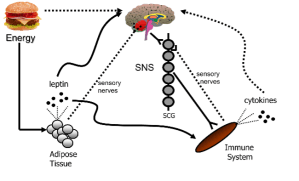
There are energetic tradeoffs between reproduction and immune function. The experimental reductions in total body fat suppress both reproduction and humoral immune responses, suggesting that immunity, like reproduction, tracks seasonal fluctuations in body fat. Despite the link between energy availability and immunity, the precise mechanisms by which energy availability (i.e., body fat) is interpreted by the brain and translated into a physiological signal indicating current energy balance were not fully understood. Siberian hamsters housed in short days display gonadal regression, decreases in total body fat, as well as reduced humoral immunity; exogenous leptin mimicking long-day levels of the hormone attenuated these immune impairments. We demonstrated that exogenous leptin increases circulating levels of the proinflammatory cytokine interleukin (IL) 1β while inhibiting the anti-inflammatory cytokines IL-4 and IL-12. We also demonstrated an important role for the SNS in leptin-induced immunoenhancement by showing in vivo, but not in vitro leptin-enhanced antibody production and that in vivo immune enhancement was blocked by either global chemical denervations or targeted surgical denervations of the spleen. More recently, our lab have been examining the contributions of specific energetic fuels and signals to seasonal variation in sickness intensity. We found that seasonal variation in sickness-induced hypothermia was regulated by seasonal changes in glucose availability and leptin levels; however, seasonal changes in sickness-induced anorexia and body mass loss were regulated by seasonal differences in body mass more generally. Insulin, a pancreatic hormone secreted in response to positive energy balance, has both suppressive and enhancing effects on sickness intensity, depending on energetic and reproductive context.
Microbiome Influences on the Neuroendocrine Regulation of Social Behavior
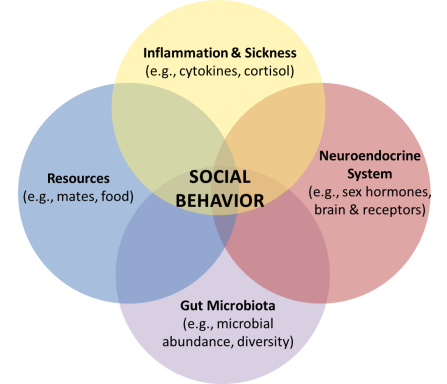
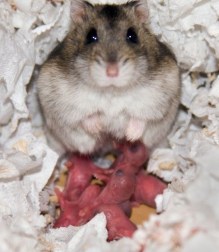
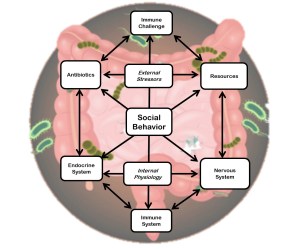
The large intestine of the mammalian gastrointestinal tract contains approximately 100 trillion microorganisms, an amount ten times greater than the total number of cells in the body. This diverse group of symbiotic bacteria, called the gut microbiome, is critical for mammalian survival and exerts a surprisingly powerful influence on the brain and behavior. Interestingly, microbiota can be transmitted from mother to offspring and, thus, alter offspring neurobehavioral development. Our lab is interested in elucidating the physiological mechanisms by which the gut microbiome shapes the development of social behaviors. Currently, we are investigating the consequences of altered maternal microbiome on the neural, endocrine, immune, and behavioral responses of offspring.

Neuroendocrine Mechanisms of Seasonal Aggression
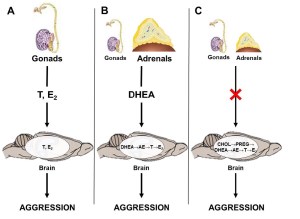
Many non-tropical mammals, such as Siberian hamsters, undergo seasonal changes in a wide array of physiological and behavioral responses. Specifically, some animals regress their reproductive systems and exhibit decreased circulating levels of androgens during the winter non-breeding season, but “re-grow” their reproductive organs and elevate circulating gonadal steroid levels in time for the impending summer breeding season. Interestingly, some species exhibit equivalent or increased levels of territorial aggression outside of the breeding season. Previous work from our lab has provided evidence that Siberian hamsters undergo a “seasonal switch” in neuroendocrine mechanisms between the breeding and non-breeding seasons, in which the adrenal hormone precursor dehydroepiandrosterone (DHEA) facilitates increased territorial aggression during the non-breeding season. Currently, we are continuing our work on the neuroendocrine mechanisms underlying seasonal aggression by examining the role of adrenal DHEA as a precursor of neurally-derived steroids in breeding and non-breeding hamsters.
 Demas Lab